In this post, you will learn:
- The challenges of building on a hill
- Options for building a sunroom addition to a hillside home
- The benefits of a two-story sunroom
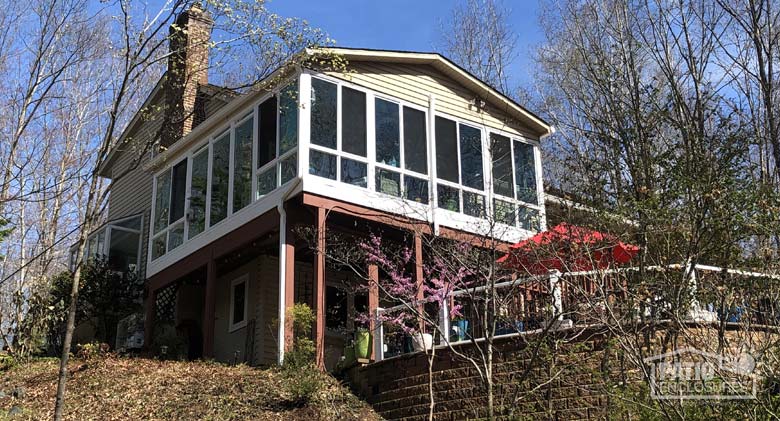
If your home is situated on a hill or slope, you already know that these locations offer unique benefits. Homes built on hills often enjoy beautiful views, stunning landscaping, great natural lighting, privacy, and the extra space that a walk-out basement provides. But you are also probably aware of the difficulty of building home additions on a hill. While construction on a slope can be challenging, it is certainly not impossible. If you are considering a 2-story sunroom addition for your hillside home, here is what you need to know, from the challenges to your best options.
Challenges of Building a 2 Story Sunroom on a Hill
Multiple considerations determine the difficulty of building on a particular hill, but the two main challenges are the hill's gradient rating and whether the slope is upslope or downslope.
What Is a Gradient Rating and How Does It Affect Construction?
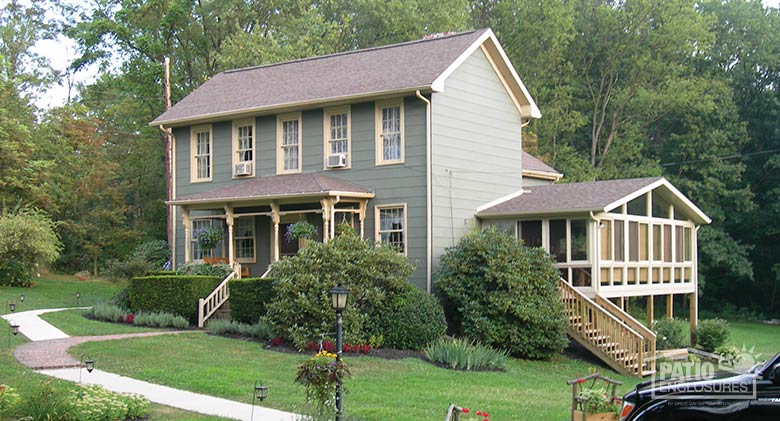
A gradient rating is expressed as a percentage and indicates the steepness of an incline. A higher grade, or percentage, means a steeper hill. This rating gives you a good idea of how challenging a construction project will be.
- Less than 10% incline: This is considered slight and is the easiest to build on.
- Between 11% and 20% incline: This is deemed moderate.
- Anything above 20% incline: This is considered steep.
When a hill has a grade of more than 15%, building costs tend to increase because the risks are higher and the work becomes more complex. Houses can be built on grades of as much as 50%, but because the complex foundation systems required for such houses are so expensive, they can cost more than an entire house on level ground! Even moderately sloped sites usually need more concrete and deeper excavation, commonly involving specialized equipment or even blasting.
Is Your Home on an Upslope or Downslope?
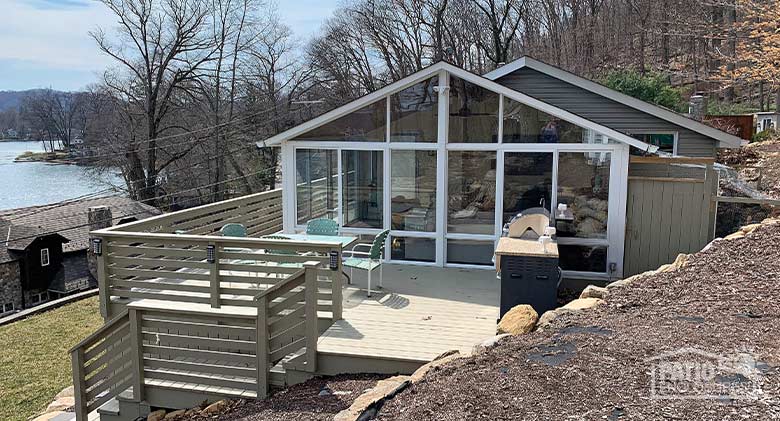
An upslope plot means the back of the house sits higher than the front. Building on this type of land is generally more challenging than on downslope sites. Upslope projects often require cutting into the hill and transporting and disposing of the excavated rock and soil.
Sunroom Options for Homes Built on Hills
If your home is built on a hill, a sunroom may be the perfect addition. Below are some excellent ways to incorporate a sunroom, three-season room, or screened-in porch into your house on a hill, with a special focus on multi-level designs, such as a 2-story sunroom addition.
Second Story Sunroom
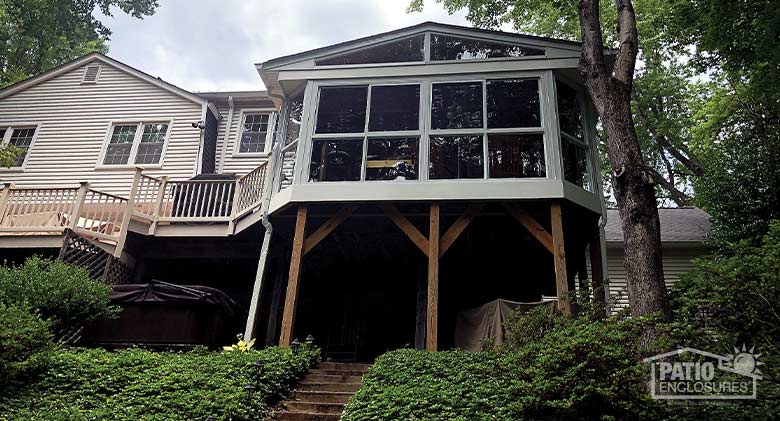
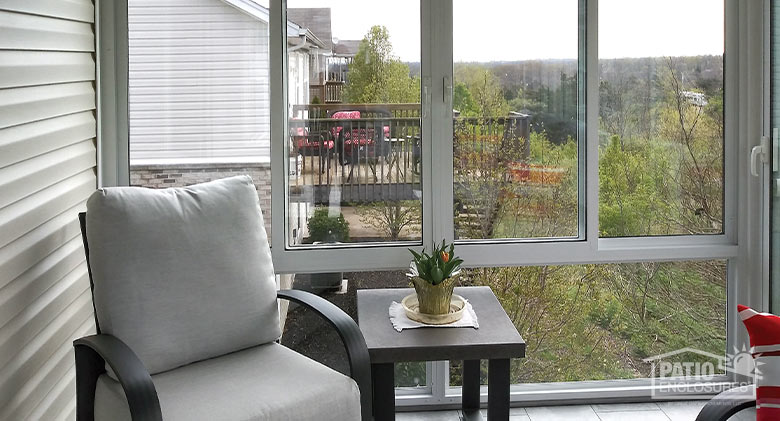
A second-story sunroom is a great option for a home with a unique layout, such as one built on a hill. For example, if your backyard has a downward-sloping hill and an elevated deck off the main floor, you can add a sunroom to your existing deck. This allows you to enjoy your beautiful backyard view year-round. If you still want to enjoy an open-air space, the area under your second-story sunroom can be transformed into a covered patio.
For a hillside home, a second-story sunroom addition may be more cost-effective than a traditional home addition, which, as we know, requires special excavation equipment and a complex foundation system. A second-story sunroom offers all the benefits of a traditional home addition, including:
- Additional functional square footage for entertaining, working from home, crafting, exercising, or relaxing.
- Increased real estate value.
- Improved natural light in your home.
Two Story Sunroom
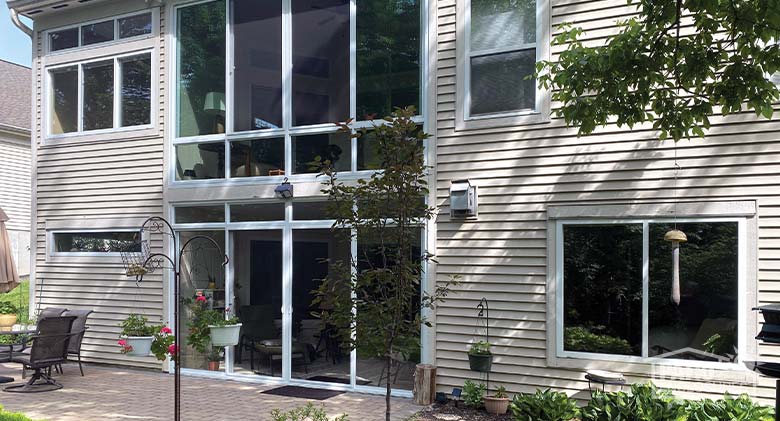
Why not make the most of your home's vertical space with a two-story sunroom? A 2-story sunroom consists of two enclosures, one built directly on top of the other. This design works exceptionally well for homes that have great views from both the first and second floors. Much like second-story sunrooms, a two-story sunroom addition is an ideal solution for houses built on hills with backyards that slope downward.
A two-story sunroom adds more living space, natural light, and great views. The lower level can be an enclosed patio or an extension of your ground floor. The upper level can connect to a bedroom or living area, creating a private retreat. This flexible design gives you two separate spaces and an eye-catching feature for your home.
Add a Sunroom Addition on Your Hillside Home with Patio Enclosures
If you’re thinking about adding a sunroom to your house on a hill, our team of experts can help you create the addition of your dreams. We design and build each of our sunrooms to fit your exact needs and budget. Our trained design consultant will assess your space, listen to your ideas, and develop a personalized plan for your individual home. Schedule your free, in-home estimate today.
 You May Also Be Interested In: